







Fun with Ragdolls Plus





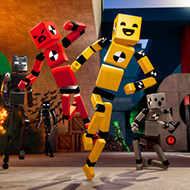
You send Dummy Danny sprinting toward the edge of a collapsing platform, mistime the jump, and watch his limbs go completely loose mid-air before he crumples against a wall. That flop is the whole point. Fun with Ragdolls Plus builds its identity around exactly that kind of moment, mixing a physics-driven platformer with a story campaign and a sandbox that lets you cause the same chaos on your own terms.
| Genre | Physics platformer / sandbox |
| Platforms | PC, mobile |
| Core Modes | Story Mode, Sandbox Mode |
| Main Characters | Dummy Danny, Rickie Ragdoll |
Dummy Danny and the Story Mode Premise
Story Mode centers on Dummy Danny and his friend Rickie Ragdoll, two competitors forced into a series of mini-games under the promise that winning earns them freedom. It sounds simple in the opening minutes, but the game keeps peeling back layers until the “freedom” on offer looks a lot less generous than advertised. Danny starts optimistic and eager to help Rickie, which sets up most of the emotional weight once their goals stop lining up.
The friendship between Danny and Rickie is the actual engine of the campaign, not the obstacle courses themselves. Rickie’s obsession with climbing a competitive scoreboard pushes him toward choices that strain the partnership, and players who care about narrative pacing tend to bring this up in discussion threads more than the platforming itself. The betrayal beat lands harder because the early chapters spend real time letting the two ragdolls just goof around together.
By the time Danny starts questioning what winning actually means, the game has already trained you to expect physics comedy over sincerity, so the tonal shift catches a lot of first-time players off guard. That contrast between slapstick ragdoll movement and a genuinely darker narrative thread is one of the things players bring up most when describing what makes the campaign memorable.
Combat and Movement in Fun with Ragdolls Plus
Combat stays intentionally light: punching, throwing bombs, and shooting cover most encounters, and none of it is trying to be a deep fighting system. What sells it is the ragdoll physics underneath every hit, since a punch that lands slightly off-angle can send an opponent spinning across a platform instead of just stumbling back. Early on, players mostly get this wrong by treating fights like a normal platformer and forgetting momentum carries between hits.
Movement uses the same physics logic. Jumps, climbs, and ledge grabs all interact with the ragdoll’s loose-limbed body, which is why timing matters more here than in a typical platformer. A dedicated ragdoll toggle lets you flop your character on command, and while it exists mostly for chaos, speedrunning-minded players have started experimenting with it as a way to slide under obstacles faster than a normal jump allows.
- Punching for close-range crowd clearing
- Thrown bombs for gaps and grouped enemies
- Shooting for distance encounters
- Manual ragdoll flopping for movement tricks
As the campaign progresses, obstacle courses stack hazards on top of each other instead of introducing new mechanics, so difficulty comes from combining familiar tools under tighter timing rather than learning something entirely new.
Collecting Gears Across the Campaign
Gears are scattered through the levels as the main collectible, and grabbing them becomes a habit long before the game explains why. Completionist players chase every Gear on a first playthrough anyway, since exploring the edges of a level often reveals shortcuts that help later on replays. Once you reach one of the later obstacle gauntlets, having already learned the layout from Gear hunting pays off in a very concrete way.
The lack of a hard unlock tied to Gears is one of the more debated points in the community. Some players see it as a missed opportunity, arguing the collectible needed a cosmetic or gameplay payoff. Others treat it as a low-pressure side activity that doesn’t distract from the story, which keeps the pacing tighter than a typical collectathon.
Sandbox Mode Tools and the Merge Crate
Sandbox Mode is where Fun with Ragdolls Plus turns from a guided campaign into an open toybox. Recent updates added a Laser Emitter, Laser Receiver, and Laser Reflector, which together let builders route beams around a level instead of firing them in a straight line only. Combined with Cannons that now support Auto Aim and Cannon Auto Fire, builders can wire up automated hazard courses that trigger without anyone standing there to press a button.
The Merge Crate is one of the newer sandbox pieces players talk about, letting you combine placed objects into single interactive setups instead of stacking loose parts by hand. Builders who spend hours in Sandbox Mode tend to treat it as a puzzle design tool first and a chaos generator second, even though most casual players just want to watch a Ragdoll Cannon launch Danny across the map.
World sharing means you’re never stuck designing everything from scratch. Browsing community builds is often the fastest way to see what the newer sandbox items are actually capable of before attempting your own.
What Players Debate About Fun with Ragdolls Plus
The most common criticism centers on Gears feeling underused, but a close second is the shift away from the first game’s heavier sandbox focus. Fun with Ragdolls Plus leans harder into story than its predecessor, and longtime fans of pure sandbox building sometimes feel the campaign takes up space that used to belong to freeform creation. Newer players who came in for Dummy Danny’s story tend not to notice this trade-off at all.
What happens when you accidentally trigger the ragdoll button mid-jump?
Danny goes fully limp and drops out of his current momentum, which usually means falling short of a platform or landing awkwardly. It is a real risk during precision platforming sections, since the ragdoll toggle shares space with other inputs and gets pressed by accident more often than players expect.
Does collecting every Gear unlock anything in Fun with Ragdolls Plus?
No hidden reward is tied to full Gear completion right now. They function purely as an exploration incentive, encouraging players to look past the obvious path through each level rather than gating cosmetics or extra content behind a full set.
Is the Sandbox Mode in Fun with Ragdolls Plus different from the first game?
Yes. Building blocks are simpler and more accessible, and newer additions like the Laser Emitter, Laser Receiver, Laser Reflector, and Merge Crate give builders tools the original sandbox never had, even though the overall focus of the sequel has shifted toward Story Mode.
Fun with Ragdolls Plus works because it never lets its darker story swallow the physics comedy that made the concept fun in the first place, and by the time Rickie’s choices catch up with him, the Gears you picked up along the way feel less like a checklist and more like a record of the path Danny took to get there.
Comments
There are no reviews yet. Be the first one to write one.
