









Know Your Role
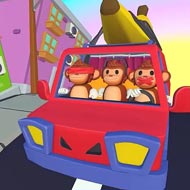
You’re the Deaf Monkey, and the one teammate who could tell you what to do next just moved both hands at once and stopped moving. You can see the bomb glowing right in front of you, every wire and light in perfect detail, but the voice chat your other two teammates are talking through is completely silent on your end. The Mute Monkey just answered a question you asked out loud, except you have no idea what that gesture meant, and the Blind Monkey is still waiting on you to say something, anything, before their hand moves. That’s a normal thirty seconds in BOMBANANA!, a three-player co-op bomb-defusal game where nobody at the table has full information, and every module that gets cleared is really a small miracle of translation.
| Role | Can | Cannot |
| Blind Monkey | Touch and operate bomb modules directly; read Braille-style raised panels by touch | See the bomb screen or its colors; read the manual; solve the puzzle mentally |
| Deaf Monkey | See the bomb screen clearly; speak instructions aloud | Hear any teammate’s voice chat or audio |
| Mute Monkey | Read the defusal manual exclusively; communicate through gestures and emotes | Speak a single word |
Right now BOMBANANA! exists as a downloadable Steam demo, with the full release planned for August 2026 on Windows. During its Steam Next Fest run in June 2026 the demo reportedly pulled in more than 675,000 players and over a million library adds, becoming the most played demo of the festival on the strength of exactly this kind of three-way scramble, backed by an overwhelmingly positive rating from thousands of reviews.
Every bomb runs on the same basic imbalance between the three seats at the table. The player who can see doesn’t have the manual. The player who has the manual can’t speak a word. The player whose hands are actually on the bomb can’t see or hear either of the other two. None of the three roles below is complete on its own, which is the entire point.
The Blind Monkey: Hands on the Bomb, Eyes on Nothing
The Blind Monkey is the only player who actually touches the bomb. Every other piece of information reaches this player secondhand, because the Blind Monkey cannot see the bomb screen or its colors, cannot read the defusal manual, and cannot work out a solution mentally even if they wanted to. What this role does have is touch: raised, Braille-style panels built into certain modules that only the Blind Monkey can feel and interpret, reporting each digit back to the team one at a time as it’s read off the panel.
The rule that defines the role is patience. The Blind Monkey executes exactly one action per confirmed instruction cycle, whether that’s one wire cut, one digit typed into a keypad, or one switch flipped, and never acts before that instruction has actually been confirmed by the team. That sounds simple until the timer is running, the Deaf Monkey is mid-sentence, and every instinct is screaming to just start touching things.
In practice this role is less about the puzzle and more about trust. The Blind Monkey has no way to verify anything they’re told; the Deaf Monkey could describe a wire wrong, or the Blind Monkey could mishear which of several similar instructions applies, and there’s no way to catch that except by asking for the instruction again. Good Blind Monkeys treat any unclear command as worth double-checking before their hand moves, even at the cost of losing a few seconds off the clock.
None of that changes based on which module happens to be active on a given bomb. The discipline stays identical every time: touch, report if there’s something to report, and wait for the word before acting.
The Deaf Monkey: BOMBANANA!’s Bottleneck
The Deaf Monkey sits opposite that problem. This player can see the bomb screen in full detail and can speak freely, but cannot hear a single word either teammate says through voice chat. Their job is to read the bomb’s visible state out loud for the Blind Monkey and to translate whatever the Mute Monkey is gesturing into spoken instructions the Blind Monkey can actually follow.
Guides consistently point to the Deaf Monkey as the bottleneck of the team, and the reason is straightforward: this player has to watch the bomb screen and the Mute Monkey’s gestures at the same time, then narrate both out loud without losing track of which piece of information belongs to which module.
That split attention is where most communication actually breaks down. A Deaf Monkey staring at the bomb screen can miss a gesture entirely; one watching the Mute Monkey too closely can fall behind on reading out the wire colors or switch positions the Blind Monkey is waiting on. There isn’t a clean way to remove that tension, only to get faster at switching between the two halves of the job.
Because the Deaf Monkey is the only one who can speak and be heard, it’s tempting for this player to narrate constantly rather than pausing between updates. Clear breaks between one piece of information and the next tend to keep both the bomb screen and the Mute Monkey’s gestures readable, instead of turning into one continuous run-on stream that the Blind Monkey has to untangle.
The Mute Monkey: All the Answers, None of the Words
The Mute Monkey holds the one resource nobody else on the team has access to: the defusal manual. This player looks up the correct answer for whatever module is currently active, but can’t say a single word out loud to share it with anyone.
Everything the Mute Monkey knows has to travel through gesture and emote, aimed specifically at the Deaf Monkey, since that’s the only teammate who can actually see them clearly. The Deaf Monkey then converts those gestures into spoken instructions for the Blind Monkey, which means the Mute Monkey is effectively two steps removed from the player whose hands are actually on the bomb.
This is arguably the most mentally demanding of the three roles, because the Mute Monkey has to compress a manual lookup, sometimes one involving a wire count, an indicator light color, or a matching digit sequence, into gestures precise enough that the Deaf Monkey doesn’t misread them. A vague point or a rushed gesture is often exactly where a correct answer turns into a wrong cut.
There’s no way to shortcut that pressure by simply moving faster. The gesture still has to be precise enough for the Deaf Monkey to convert it into something the Blind Monkey can act on immediately, without a follow-up question eating into the time the team has left.
Why the Chain Breaks: Communication in BOMBANANA!
Information always moves in the same direction: the Mute Monkey reads the manual, signals the Deaf Monkey with a gesture, the Deaf Monkey speaks that instruction to the Blind Monkey, and the Blind Monkey executes it. Every module on every bomb runs through that same four-step relay, and a run only goes smoothly if each link in that chain holds up under pressure.
That structure isn’t an accident of the setup; it’s the whole design. At no point does any single player hold enough information to solve a module alone, which is exactly what forces the constant back-and-forth between all three roles instead of letting one player quietly carry the rest of the team through a module by themselves.
One of the most commonly recommended habits among players is to agree on a small gesture dictionary before the timer even starts, rather than improvising signs in the moment. At minimum, most guides suggest settling on:
- A gesture for “wait”
- A gesture for “yes”
- A gesture for “wrong” or “no”
Skipping this step is a common reason teams end up arguing mid-puzzle about what a gesture was actually supposed to mean, usually right when the clock least allows for it. The other rule worth adopting alongside it is just as simple: nobody cuts, presses, types, or flips anything until the instruction has been repeated back and confirmed once, which costs a couple of seconds but tends to save far more than that in wrong guesses.
Mistakes That Sink a Run Early
Most of the mistakes that show up in player guides for BOMBANANA! aren’t puzzle-logic errors at all; they’re breakdowns somewhere in the relay between roles. The same handful keep coming up for new teams working through their first few bombs.
- Trying to play with only two players, when the game requires exactly three to fill all three roles
- The Blind Monkey touching or acting on the bomb before the Deaf Monkey has finished reading out the current module state
- The Mute Monkey miming digits without first pointing to the correct manual page or row
- Ignoring “Braille ownership” by letting a teammate guess at a Braille value instead of waiting for the Blind Monkey’s own reading
- Skipping role rotation between runs, so the same player always ends up playing the same role
Most of these are easy enough to fix once a team recognizes them, and rotating roles between runs tends to fix more than one problem at once, since it forces everyone to actually understand what the other two roles experience rather than just their own corner of the bomb.
Left unaddressed, these habits compound fast: a Blind Monkey who’s used to acting early keeps forcing wrong cuts, a Mute Monkey who never points to the manual row keeps producing gestures nobody can parse, and the run ends in a chain of wrong answers before the timer even gets tight. Naming the mistake out loud after a failed run is usually enough to stop it from repeating on the next one.
Can two players share a role in BOMBANANA!?
No. The game requires exactly three players, one in each of the Blind Monkey, Deaf Monkey, and Mute Monkey roles, and attempting to play with only two is one of the most common early mistakes new teams make.
What happens if the Blind Monkey acts before confirmation?
Acting before an instruction has been confirmed is one of the most common ways a run goes wrong, since the Blind Monkey has no independent way to check whether what they heard matches what the Mute Monkey actually intended. The recommended rule is that the Blind Monkey never cuts, presses, types, or flips anything until the instruction has been repeated back and confirmed once by the team.
Who is allowed to report a Braille reading?
Only the Blind Monkey. Teammates guessing at a Braille value themselves, instead of waiting for the Blind Monkey’s own digit-by-digit report, is called out directly in player guides as a mistake worth avoiding.
Should the same player always play the same role?
Guides recommend against it. Rotating roles between runs is a commonly recommended practice, since it helps every player understand what each of the three roles actually experiences rather than just their usual one.
BOMBANANA! isn’t really a puzzle game in the traditional sense; it’s a communication drill wearing a bomb-defusal costume, and the three-monkey structure is what makes that work. The Mute Monkey can read every answer correctly and it still won’t matter if the gesture never lands with the Deaf Monkey, and the Blind Monkey’s hands are only as good as the last confirmed instruction they received. Teams that treat the relay itself as the puzzle, and not just the bomb, are usually the ones still talking to each other by the time the last module clears.
