









Duo Vikings 3







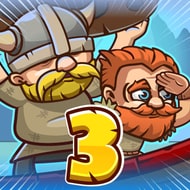
The shield in Duo Vikings 3 does not work the way a shield usually does: instead of only blocking hazards, it doubles as a makeshift glider that carries the Yellow-Bearded Viking across gaps the Red Viking cannot clear alone. That detail sets the tone for the whole game, where the two heroes are built to fail alone and succeed only when their tools line up.
Duo Vikings 3 is the third entry in the castle-crawling series, keeping the same two characters: the Red Viking, smaller and helmetless but carrying a hammer heavy enough to smash walls and enemies in one hit, and the Yellow-Bearded Viking, slower but armored with a shield that blocks hazards, glides over pits, and can protect his partner. Neither Viking finishes a level alone, and the exit only opens once both reach it.
The Shield Trick Duo Vikings 3 Never Explains Upfront
Most players assume the shield is purely defensive at first, since early rooms only ask you to block a swinging hazard. The glide function shows up a level or two later without warning, and the first time a gap is too wide for the Red Viking’s jump, the answer is usually to send the Yellow-Bearded Viking across on the shield instead of hunting for a hidden platform.
Movement uses A and D or the arrow keys, jumping is W or the up arrow, and the hit or use action on S or the down arrow does different things depending on which Viking is holding it.
Beginners often brute-force a room by rushing one character ahead, only to realize the level was built around both being in specific spots at once. Backtracking for the slower Viking costs more time than moving together from the start.
Why the Red Viking’s Hammer Is Not Just an Attack Button
The hammer breaks walls and crushes enemies, but it also smashes breakable objects that block a path or hide a trigger. Completionists chasing every hidden panel swing at anything that looks slightly different from the surrounding wall, since later rooms disguise these sections as ordinary scenery.
Difficulty rises gradually: early rooms teach one mechanic at a time, but once rising platforms, spike pits, and color-coded doors appear in the same room, a single mistimed jump can undo several steps of progress.
A room pairing a smashable wall with a spike pit expects the Red Viking to clear the wall before the Yellow-Bearded Viking glides across what’s left, and that sequencing is easy to miss the first time through.
Pressure Plates, Timed Buttons, and Color-Coded Doors
Duo Vikings 3 leans on a small set of recurring mechanisms, and knowing what each demands saves a lot of restarts.
Pressure plate: a floor switch active only while a Viking stands on it, usually meaning one hero holds position while the other moves through a door that opens only while it’s weighted down.
Timed button: a switch that opens a door or platform for a fixed window before resetting, forcing both Vikings to move the instant it’s pressed rather than one at a time.
Lever: a mechanism that toggles elevators or gates permanently once pulled, often placed opposite the door it controls, so pulling it can trap the wrong Viking on the wrong side if the order is off.
Color-coded door: a locked path tied to a switch or plate elsewhere in the level rather than a key you carry, and rooms combining one with a timed button stop being about one trick and start being about sequencing several without a mistake.
Switching Between Both Vikings When You Play Duo Vikings 3 Alone
Solo players control both heroes by switching between them, changing the rhythm of every puzzle since timing a pressure plate against yourself means planning the sequence before moving. Some rooms that feel trivial in local co-op turn into a slower, more deliberate puzzle running both Vikings solo.
Local co-op on a shared keyboard is still how most people experience the later castle rooms, since timing windows on some levers and timed buttons get tight enough that switching characters mid-puzzle costs precious seconds.
Players chasing a clean solo run often pre-drop the Yellow-Bearded Viking on a pressure plate before switching to the Red Viking, faking the timing a second player would normally provide.
Does Duo Vikings 3 have a single-player mode?
Yes, solo players switch control between the Red Viking and the Yellow-Bearded Viking at any point, though every puzzle relying on the shield’s glide or a held pressure plate has to be planned before moving.
What does the shield actually do in Duo Vikings 3?
Beyond blocking hazards, the shield lets the Yellow-Bearded Viking glide across gaps and can protect the Red Viking from an incoming attack, making it closer to a second tool than a defensive item.
Are the levels in Duo Vikings 3 harder than the earlier games?
The core mechanics carry over, but later castle rooms combine pressure plates, timed buttons, and color-coded doors more often, raising difficulty without introducing anything new to learn.
Duo Vikings 3 keeps circling back to the same idea: the Red Viking’s hammer and the Yellow-Bearded Viking’s shield are only half a solution each, and the castles are built so neither works without the other standing in the right spot.
Comments
There are no reviews yet. Be the first one to write one.
